
AI Scribes Save 16 minutes a Day, Says JAMA. Diagnostic Reporting Needs More Than That
The largest study of ambient AI scribes ever conducted just delivered a reality check. Here's what it found, and why radiology and pathology were never really the subject of study.
PRAID AI Team · Sep 2, 2026 · 8 min read
What the study actually measured
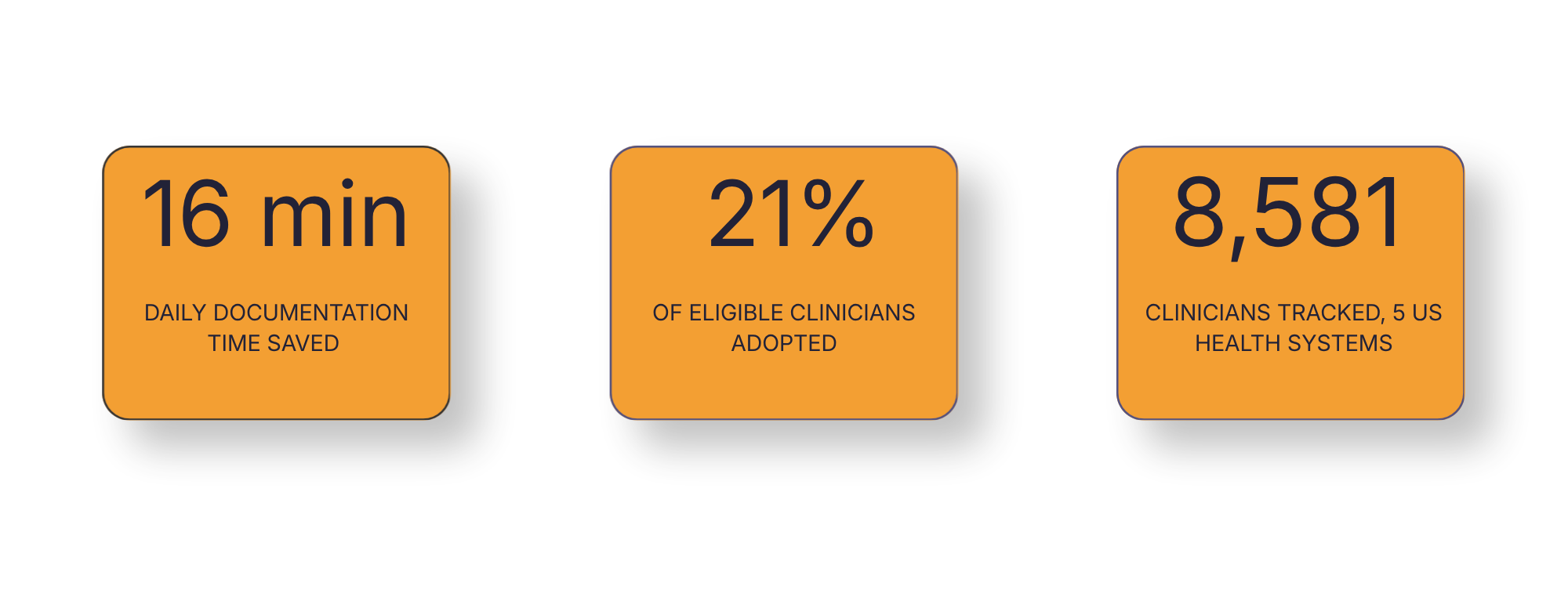
Researchers from Mass General Brigham and UCSF, working as part of the Ambient Clinical Documentation Collaborative, tracked ambulatory clinicians across Mass General Brigham, Emory Healthcare, UCSF, Yale New Haven Health, and UC Davis between 2023 and 2025. Of the 8,581 eligible clinicians, 1,809 adopted an ambient AI scribe. The remaining 79% chose not to.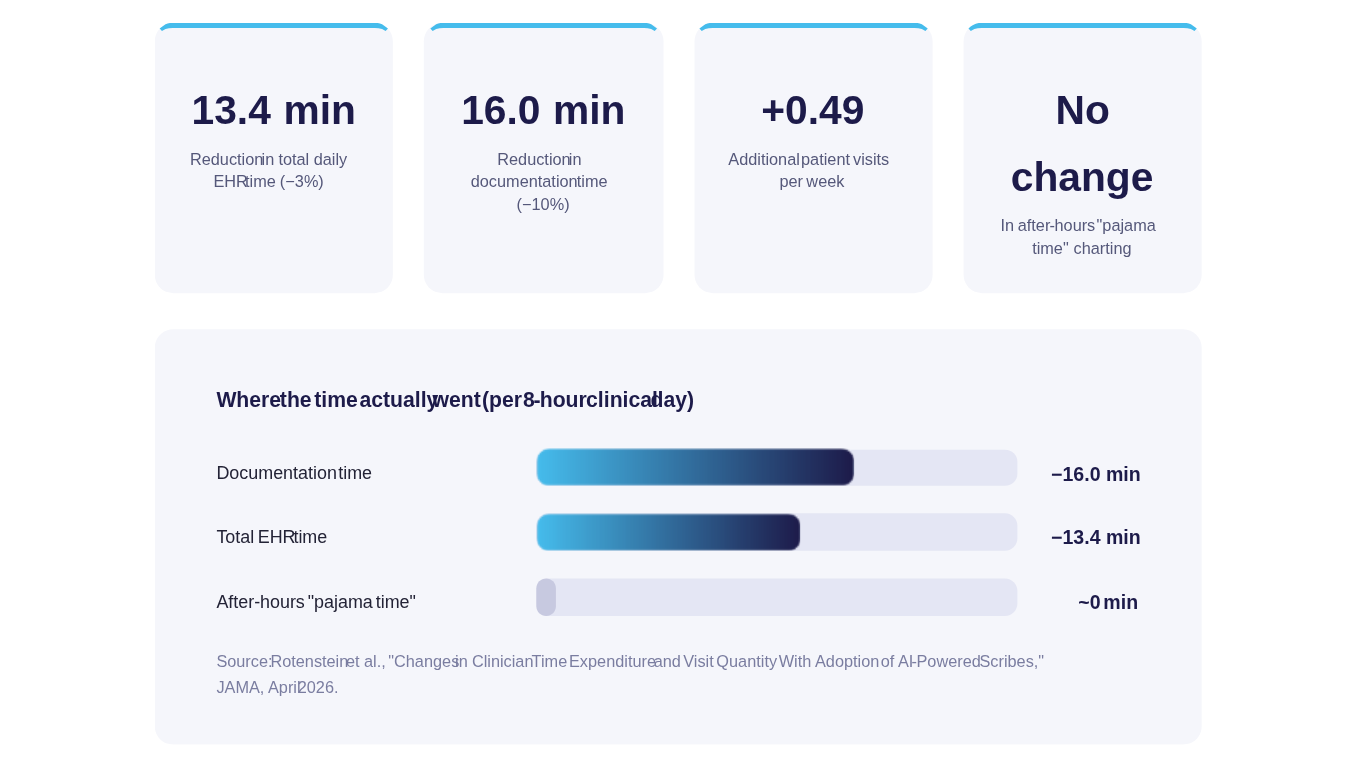
Why is the number modest and why that's the right result
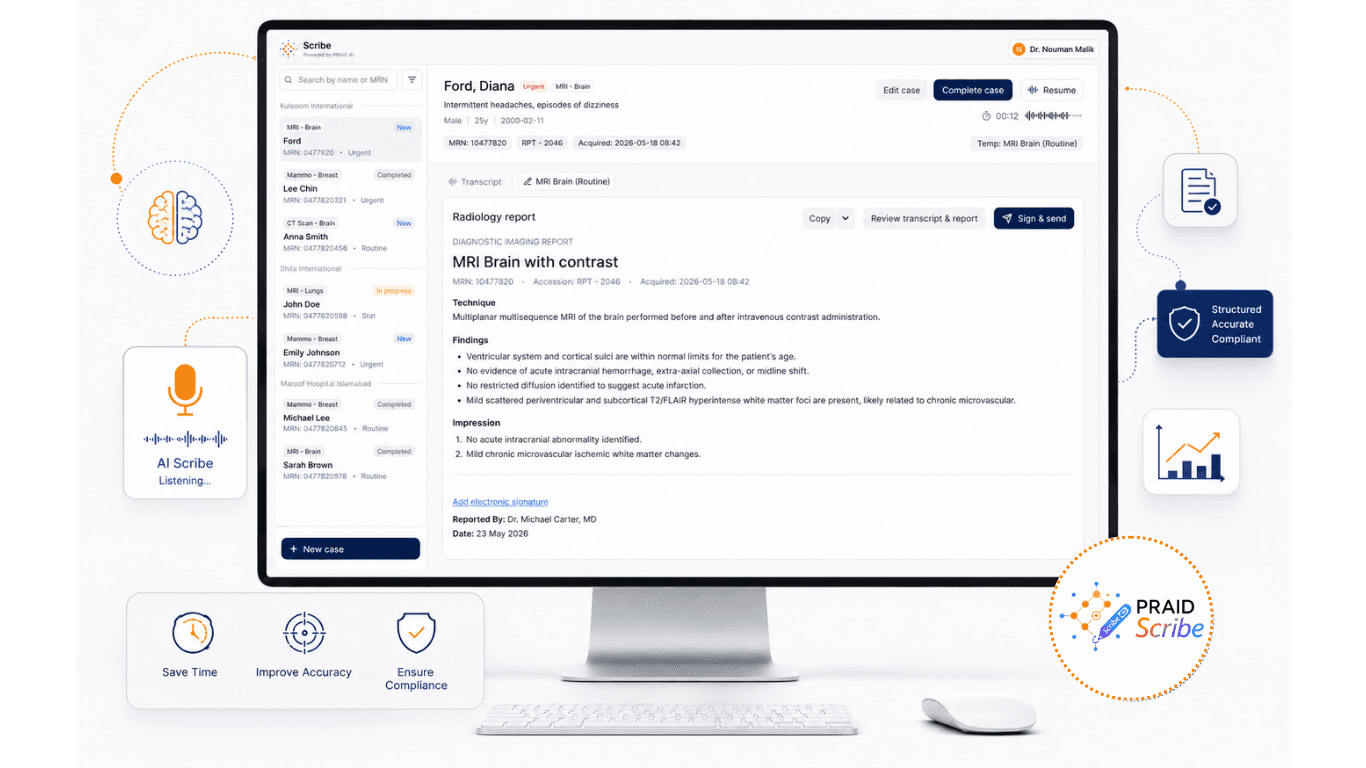
Ambient scribes like the ones studied, Ambience, Nuance DAX Copilot, and Abridge, were built to solve a specific problem: turning a spoken conversation between a clinician and a patient into a reasonably good clinical note. That's a real problem, and they're getting better at it. But it's a fundamentally different problem from structured diagnostic reporting. A primary care visit is a conversation. A radiology or pathology case is not. There's no patient in the room to talk to, there's an image, a slide, a set of findings that need to be dictated against a fixed clinical vocabulary, mapped to a structured template, and signed off in a form that a RIS, a PACS, or a referring physician can actually use. Shaving 16 minutes off a conversational note is a workflow tweak. Getting a CT report from spoken findings to a signed, structured, standards-aligned document is a different category of work entirely.What the JAMA study tested
- Ambient listening during patient conversations
- General ambulatory note generation
- Primary-care and outpatient encounters
- Free-text summarization, not structured coding
What diagnostic reporting requires
- Terminology-aware dictation, no patient conversation
- Section-by-section structured reports
- Template alignment to ACR / CAP / RCPath standards
- Direct, sign-off-ready output into RIS/PACS
The category is about to be forced to specialize
Two pressures are converging on radiology and pathology reporting right now. The first is evidentiary: JAMA-level data is now publicly establishing that general-purpose ambient scribes deliver real but modest gains, which raises the bar for any tool that wants to claim more than that. The second is structural, the reporting software radiologists have used for over a decade is being retired.- Early 2026 Microsoft begins sending end-of-life notices for PowerScribe 360, the dictation platform that has held roughly 75% of the U.S. radiology reporting market since its 2010 launch.
- August 31, 2026 Annual renewals and maintenance for PowerScribe 360 end. Departments are pushed toward a cloud subscription successor, with existing pricing agreements no longer honored.
- August 31, 2027 Full support ends. Radiology groups that haven't migrated are left running unsupported, mission-critical reporting infrastructure.
The gap this leaves open
A generation of ambient scribes has proven it can shave minutes off a conversation. Almost none of them are built, certified, or templated for a radiologist or pathologist signing off a structured, standards-aligned report under a medical device framework. That's a narrower problem, and a harder one.
Where PRAID Scribe fits
This is the specific gap PRAID Scribe was built for. Not another ambient listening layer for conversations that don't happen in a reading room, a reporting engine built from the ground up for radiology and pathology, as a CE-marked medical device under MDR EU, with ISO 13485 and EUDAMED registration.Built for the case, not the conversation
Real-time speech turned into structured, section-by-section reports — findings, impressions, measurements — without a patient dialogue to summarize.
Standards-aligned by default
Templates aligned to ACR radiology reporting guidance and CAP / RCPath pathology dataset structures, recognized by clinicians and auditors alike.
Regulated, not just fast
CE Marked (MDR EU), ISO 13485:2016, EUDAMED-registered — a compliance posture general ambient scribes don't carry.
Multilingual reporting
English native, with Arabic conversion — built for reporting workflows across GCC, MENA, and EU markets.
Zero procurement, zero upfront cost
Individual sign-up, monthly on/off billing — a working reporting seat in a day, not a quarter-long procurement cycle.
A platform, not a point tool
Standalone today, with the full PRAID diagnostic AI operating system available behind it when a department is ready to scale.
Sources
- Rotenstein LS, et al. "Changes in Clinician Time Expenditure and Visit Quantity With Adoption of Artificial Intelligence-Powered Scribes: A Multisite Study." JAMA, April 2026. massgeneralbrigham.org
- HIT Consultant — "JAMA Study: AI Scribes Deliver Modest EHR Time Savings Across 5 Major Health Systems." hitconsultant.net
- Healthcare IT News — "AI scribes can reduce EHR charting, more so when used frequently." healthcareitnews.com
- The Imaging Wire — "Microsoft Sunsets PowerScribe 360 Reporting Software." theimagingwire.com
- Radiological.ai — "What Is PowerScribe 360? A Plain Guide for Radiology Groups." radiological.ai
Start using Praid AI today
- AI-assisted radiology and pathology tools
- Secure, compliant, and easy to integrate
- Manage all your work in one place
Bring PRAID AI to your practice
Seamlessly integrate AI-powered precision into your clinical workflow and unlock faster, more accurate diagnoses for every patient.