
PRAID AI Launches Clinically Certified AI Assistive Tools, Transforming Radiology & Pathology in Saudi Arabia & UAE
PRAID AI Team · Apr 7, 2026 · Max 18 min read
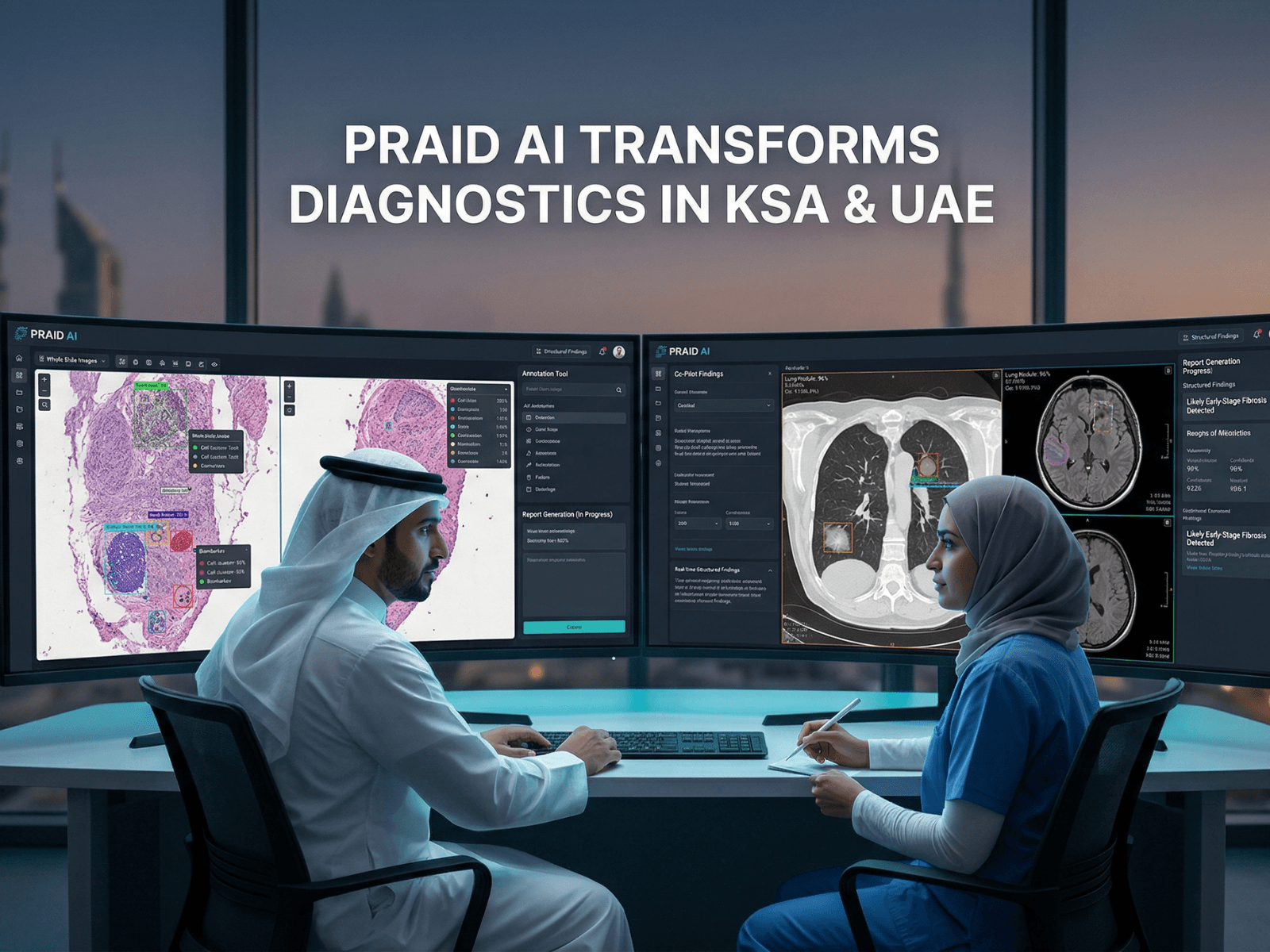
PRAID AI is a CE certified, ISO-standard diagnostic intelligence platform serving radiologists, pathologists, hospital networks, teleradiology providers, research institutions, medical trainees, universities, and AI & pharmaceutical companies worldwide. Built to the highest international regulatory standards, ISO 13485:2016 certified, EUDAMED registered on the European Commission, and CE EU REP marked, PRAID AI is not a concept or a pilot programme. It is a fully validated, commercially available solution operating in real clinical environments today.
The Middle East is a priority region for PRAID AI. As Saudi Arabia and the UAE accelerate their investment in healthcare infrastructure and digital transformation, PRAID’s architecture has been purpose-aligned to the clinical realities of the region from the diagnostic demands of institutions in Riyadh and Jeddah to the fast-scaling health networks of Dubai and Abu Dhabi. Engineered for seamless integration with existing PACS, RIS, LIS, and clinical workflows, PRAID is deployment-ready for regional health systems today, bringing the same globally certified, clinically validated intelligence that serves institutions across Europe to the MENA region.
This blog focuses specifically on PRAID AI’s Core Assistive Tools, three purpose-built capability modules that live within the PRAID AI platform itself. They are not separate products. They are integrated features of a single, unified system, each one designed to slot into a distinct stage of the diagnostic process without disrupting the clinical tools and workflows already in place. Together, they form a seamless, end-to-end layer of assistive intelligence that is accessible to any institution ready to activate it. These are not standalone replacements for clinical expertise. They are intelligent features of PRAID AI, engineered to reduce burden, improve accuracy, and accelerate output for the medical professionals who use them.
The three core capability modules within PRAID AI, each commercially available and integration-ready, are:
- The Data Annotation Tool for building high-quality, AI-ready medical imaging datasets
- The PRAID AI Co-Pilot for real-time, AI-assisted diagnostic analysis
- The Report Generation Engine for fast, structured, and compliant diagnostic reporting
Each module addresses a distinct stage of the diagnostic process. Within the PRAID AI platform, they operate as a connected, coherent system from the moment an image is captured to the moment a report is signed off and each integrates directly with the clinical software institutions already use.
PRAID serves a remarkably wide audience, from frontline clinicians to back-end researchers. This breadth is intentional: diagnostic data flows across many stakeholders, and PRAID's architecture connects them all.
PRAID is open for:
- Radiologists & Pathologists
- Hospital Networks
- Teleradiology & Telepathology Providers
- Research Institutions
- Medical Trainees & Universities
- AI Companies & Pharma
What unifies all these users is a single need: reliable, fast, and structured diagnostic intelligence. PRAID AI’s three integrated modules address this need from three different angles data creation, real-time analysis, and formal documentation all delivered through one platform, with one integration, and one compliance framework.
PRAID AI Module 01 — Data Annotation Tool
Every AI model in medicine is only as good as the data it was trained on. The Data Annotation module within PRAID AI solves the hardest problem in medical AI: creating high-quality, clinically validated labeled datasets at scale, without sacrificing speed or accuracy. It operates as a native feature of the PRAID platform, integrating directly into existing radiology and pathology workflows without requiring a separate system or additional vendor relationship.
Serving as an Open Annotation Infrastructure, this tool handles both radiology images (X-rays, CT, MRI, PET scans) and pathology slides (Whole Slide Images / WSI). Whether you're a hospital building an in-house AI model or an AI company curating training data for a specific disease cohort, this tool provides the complete pipeline.
Radiology Annotation
PRAID's Radiology Annotation tool supports all major imaging modalities through a fully automated AI-assisted pipeline — delivering expert-level annotation precision across every scan type, faster than traditional workflows.
Key features:
- Supports X-ray, Mammography, CT, MRI & Ultrasound
- DICOM upload & auto-processing pipeline
- Precision ROI annotations & measurements
- AI annotation overlays — accept or reject per finding
- Multi-scan navigation within a single case
- Full DICOM-native compatibility with secure audit tracking
Pathology Annotation (Whole Slide Images — WSI)
Designed specifically for the unique demands of digital pathology, supporting Whole Slide Images at full gigapixel resolution. Pathologists can annotate tissue regions, cellular structures, and markers with precision, from single cells to entire biopsy cores.
Key features:
- Single-organ and multi-class annotation support
- Tissue type classification tools
- Cellular-level marker annotation
- Biomarker and staining support
- AI-complete annotations with human review
- Peer review and case transfer built-in
Three Annotation Modes for Every Use Case
PRAID AI offers three distinct annotation workflows depending on the level of automation desired. Clinicians and data teams can choose the mode that best fits their quality requirements and throughput targets:
- Manual Mode: Full human control. Expert annotators draw every label from scratch. Ideal for gold-standard datasets where every annotation must be clinically verified.
- AI-Assisted Mode: AI pre-populates annotations; clinicians review and refine. The best balance of speed and accuracy. Particularly valuable for large-scale annotation projects requiring clinical sign-off.
- AI-Complete Mode: Fully automated annotation with automated quality control. Designed for large-scale dataset creation where speed is the priority and AI confidence is high.
Peer Review & Remote Collaboration
One of PRAID's standout annotation features is its built-in Peer Review & Case Transfer system. Radiologists or pathologists can instantly invite external expert collaborators simply via email, no complex onboarding required. This is a genuine enabler for teleradiology and telepathology workflows, where second opinions from remote specialists are routine but often logistically cumbersome.
Combined with the platform's VLM-Assisted Multimodal Re-Analysis capability, annotators can request an AI re-read of ambiguous cases using vision-language models to surface alternative interpretations or flag missed regions.
PRAID AI Module 02 — The Co-Pilot
The Co-Pilot is where PRAID AI’s intelligence becomes most visible in clinical practice. Built as a core module of the platform rather than a standalone application, it is an embedded Vision-Language Model (VLM) that works directly within the diagnostic workflow — not a sidebar chatbot, but a deep, context-aware analytical partner that works on what it sees, in real time, inside the same environment where clinicians already work.
"The Co-Pilot analyses everything, it generates findings, summarises pathology, and flags anything worth a second look. Its goal is assistive intelligence, not replacing the clinician."
AI-Assisted Multimodal Analysis
Pathology findings are synthesized in real time, identifying key markers, tissue characteristics, and abnormalities across both radiology and histopathology images. The Co-Pilot maintains 93–98% concordance with expert radiologist reads.
- Real-time pathology synthesis across modalities
- Multi-organ, multi-finding detection
- 93–98% expert concordance rate
- Cross-modal analysis (radiology + pathology combined)
- Automated preliminary findings generation
- Confidence scoring per finding
Slide & Scan Analysis
Goes beyond flagging findings to provide quantitative measurements and spatial mapping of abnormalities. Lesion sizes, distribution patterns, density profiles, and regional heatmaps are generated automatically, data that typically requires manual calculation in conventional workflows.
- Lesion sizing and volumetric measurement
- Spatial distribution mapping and heatmaps
- Quantitative biomarker extraction
- Longitudinal change detection across studies
- Prior study comparison tools
Context-Driven Diagnostic Dialogue
Perhaps the most innovative Co-Pilot feature: a natural language interface that lets clinicians query their imaging data conversationally. Clinicians can ask questions like 'Is this consistent with early-stage fibrosis?' or 'Compare this scan with the prior study from 3 months ago' and receive structured, evidence-referenced answers in seconds.
- Natural language case queries
- Differential diagnosis suggestions
- Evidence-referenced AI responses
- Cross-study comparison dialogue
- Teaching case discussion mode for trainees
- Integration with full clinical context
Voice Interaction — Hands-Free Diagnosis in Real Time
One of the Co-Pilot's most powerful and distinctive capabilities is its fully integrated voice interaction system, enabling clinicians to both speak queries to the AI and issue voice commands to control the diagnostic workflow, all during live diagnosis.
This means a radiologist reviewing a scan never needs to break focus to type or click. They can speak directly to the Co-Pilot:
- Voice queries — ask the Co-Pilot diagnostic questions out loud and receive spoken or on-screen AI responses instantly
- Voice commands — navigate scans, trigger analysis, zoom into regions of interest, or compare studies using spoken instructions
- Fully hands-free operation during live diagnosis — no keyboard, no mouse required
- Real-time transcription of spoken input for documentation continuity
- Seamless transition between voice interaction and standard Co-Pilot features
This voice-first capability is particularly impactful in high-volume radiology environments and intraoperative settings where clinicians need both hands free and cannot afford to lose diagnostic momentum. It is also a significant accessibility feature — enabling specialists who face physical limitations to interact with the Co-Pilot without restriction.
Impact on Clinical Efficiency
The numbers tell a compelling story. PRAID's Co-Pilot delivers:
- 35% reduction in diagnostic errors
- 40% increase in reporting throughput
- 32% reduction in operational costs
For medical trainees, the Co-Pilot doubles as an always-available teaching tool — annotating its own reasoning, comparing findings to textbook patterns, and encouraging learning through case-level diagnostics that would otherwise require a senior supervisor.
PRAID AI Module 03 — Report Generation Engine
The Report Generation module is the third and in many ways most clinically consequential capability within PRAID AI. Rather than a bolt-on reporting tool, it is embedded directly into the platform’s diagnostic flow, receiving structured findings from the Co-Pilot and translating them into complete, compliant reports without requiring the clinician to switch systems. Reporting is the official output of the diagnostic process, the document that triggers treatment decisions, informs surgical planning, and enters the permanent medical record. PRAID treats this responsibility with the gravity it deserves.
Three Report Generation Modes
- Manual Mode: The clinician authors the report from scratch, with AI-powered spell check, terminology standardisation, and structured formatting assistance. Full creative control with intelligent guardrails.
- AI-Initiated Mode: The AI drafts the full report from scan findings; the clinician reviews, edits, and finalises. This mode cuts report authoring time by over 60%, allowing radiologists to focus on clinical judgment rather than documentation.
- Speak Mode (Voice Dictation): Voice dictation with real-time transcription and AI structuring. The clinician speaks; the system formats into a clean, compliant report. This is PRAID's most accessible reporting mode, a significant quality-of-life improvement for busy radiologists managing high scan volumes.
Structured, Compliant, Global-Ready Outputs
All generated reports follow international structured reporting standards. Reports are:
- Formatted to clinical documentation standards
- Automatically translated (supports global language coverage)
- Consistent in terminology and structure across departments
- Linked to annotated findings for full traceability
- Generated in seconds rather than minutes
- Auditable with AI-assist logs for regulatory review
- GDPR and HIPAA compliant by design
On the radiology side, reports follow ACR (American College of Radiology) Structured Reporting guidelines and RCR (Royal College of Radiologists) Guidelines for UK radiology practice. On the pathology side, outputs align with ACP (Association for Clinical Pathology) Reporting Standards, RCPath (Royal College of Pathologists) Frameworks as set by the UK Pathology College, and CAP/ABPath Equivalents for US Pathology.
Built to the Highest Clinical & Regulatory Standards
Trust in a medical AI platform is not optional, it is the foundation. PRAID has achieved the following certifications and compliance frameworks:
- ISO 13485:2016 — Software as Medical Device (SaMD)
- CE Mark under EU MDR — Confirms safety, performance, and clinical evidence for the European market
- EUDAMED Registered — European Commission's unified medical device database
For hospitals with mixed infrastructure, PRAID supports HL7 / FHIR interoperability standards, ensuring it can integrate into existing systems without disrupting established workflows.
Why PRAID Matters Now
Diagnostic medicine is under pressure. Globally, the radiology workforce gap is widening. Pathology labs are overwhelmed. Telehealth is expanding the geographic reach of diagnostics but straining specialist capacity. And the volume of imaging studies is growing year over year, driven by aging populations, expanded screening programs, and improved scanner resolution generating more data per study.
Against this backdrop, PRAID AI represents something genuinely necessary: a clinically certified, end-to-end diagnostic intelligence platform that doesn't just add AI to medicine, it rebuilds the diagnostic workflow around AI, from annotation to analysis to reporting.
What distinguishes PRAID from the many point solutions that have entered the radiology AI market is its systemic thinking. Rather than solving one problem in isolation, it addresses the entire workflow through a single integrated platform — with annotation, analysis, and reporting functioning as connected modules rather than separate tools. For institutions in Saudi Arabia, the UAE, and across the MENA region, this means a single integration point, a single compliance framework, and a platform already aligned with the clinical workflows and infrastructure priorities driving regional healthcare transformation. PRAID is not asking institutions to rebuild around it. It is built to fit around them.
For radiologists and pathologists, PRAID is a force multiplier. For hospital administrators, it is a cost and efficiency lever. For researchers, it is a data infrastructure platform. For trainees, it is a teaching companion. And for patients, though they may never see it, it is a layer of intelligence working to ensure their scan is read more accurately, more completely, and faster than ever before.
"The question is no longer whether AI belongs in diagnostic medicine. The question is which AI platform is built well enough to be trusted with it. PRAID makes a compelling case."
Ready to See PRAID in Action?
Whether you're a hospital network evaluating AI infrastructure or an individual radiologist exploring smarter workflows, a live demo is the best place to start. Booking your live demo today and experience the Unified Diagnostic Operating System firsthand.
Start using Praid AI today
- AI-assisted radiology and pathology tools
- Secure, compliant, and easy to integrate
- Manage all your work in one place
Bring PRAID AI to your practice
Seamlessly integrate AI-powered precision into your clinical workflow and unlock faster, more accurate diagnoses for every patient.